Click and collect across UAE


The Contractor’s Guide to Selecting and Using Ladders Safely on UAE Construction Sites
This Contractor’s Guide provides essential insights into selecting the right ladders and using them safely...


Waterproofing may remain invisible once a building is completed, but its performance can have a major influence on the building’s durability.
A successful waterproofing system protects structural and finishing elements from unwanted water penetration. When waterproofing fails, the visible signs may begin with a damp patch, staining or peeling paint—but the underlying problem can become much more extensive.
In the UAE, waterproofing deserves particular attention because buildings are exposed to a demanding combination of high temperatures, strong solar exposure, humidity, condensation and occasional heavy rainfall.
For contractors and property owners, and waterproofing companies in Dubai working on their behalf, waterproofing should therefore not be treated simply as another finishing activity.
It is a long-term protection system.
It is easy to associate waterproofing mainly with countries that experience frequent rainfall.
However, rainfall is only one source of moisture.
Buildings in the UAE can encounter water and moisture through bathrooms and kitchens, roof drainage, irrigation, swimming pools, groundwater, condensation, plumbing systems and occasional intense rainfall.
At the same time, exposed building elements can experience significant temperature changes.
Repeated heating and cooling can cause materials to expand and contract. Joints, penetrations and interfaces between different materials therefore require particular attention.
An effective waterproofing strategy needs to consider the entire environment in which the building operates.
Waterproofing requirements vary according to where water exposure is likely to occur.
Roofs are directly exposed to sunlight and weather.
Waterproofing systems used here must be suitable for the substrate and expected environmental exposure. Particular attention should be given to drainage points, joints, penetrations and transitions.
Even a small weakness can allow water to move beneath the finished surface and make the eventual source of leakage difficult to identify.
Bathrooms, kitchens and utility areas experience repeated water exposure.
Waterproofing below tiles helps prevent moisture from reaching screeds, walls and adjoining spaces.
Corners, pipe penetrations, floor drains and wall-to-floor junctions are particularly important because these are common locations for discontinuities in the waterproofing layer.
Below-ground waterproofing helps protect foundations, basements and other structural elements against contact with ground moisture and water.
Because these systems can become difficult to access after construction is completed, correct material selection and application are particularly important.
Balconies combine weather exposure with numerous construction details, including doors, drains, edges and wall junctions.
Proper falls, drainage and waterproofing need to work together. A high-quality membrane cannot compensate for poor drainage design.
Water-retaining structures require systems specifically suited to their application.
The selected product must be compatible with the substrate and intended use, and installation should follow the manufacturer’s technical requirements.
There is no single waterproofing material suitable for every application.
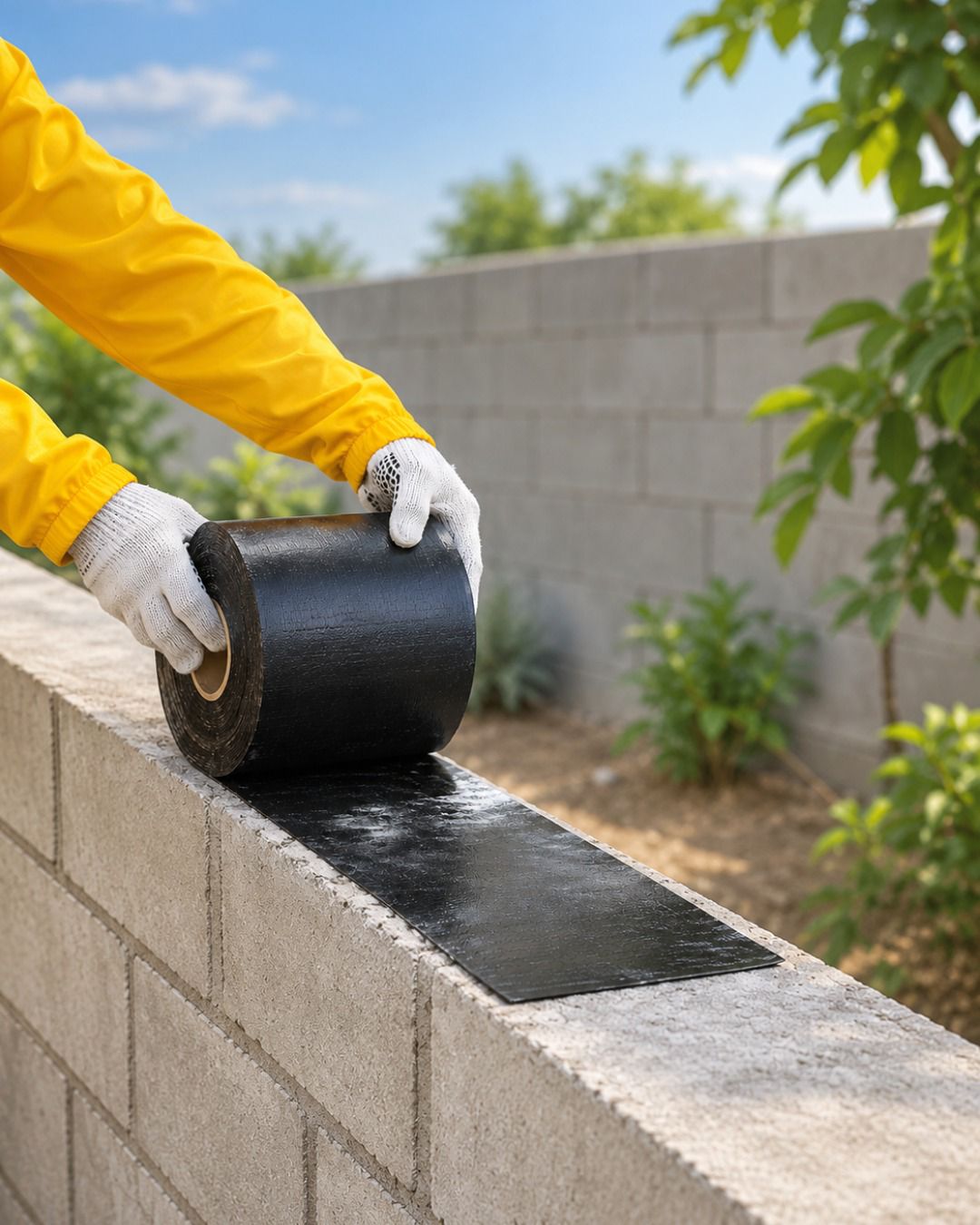
Bitumen-based products are widely used in construction and can include membranes, coatings and emulsions.
Depending on the system, they may be used for roofs, foundations and other protected areas.
Pre-manufactured waterproofing sheets provide a continuous barrier when correctly installed.
Their performance depends heavily on correct overlaps, joints, detailing and substrate preparation.
Liquid systems are applied to a prepared surface and cure to form a continuous layer.
They can be particularly useful around complex shapes and details because the system can conform to the surface.
Cement-based waterproofing systems are commonly used on concrete and masonry substrates and may be suitable for wet areas, water-retaining structures or other applications depending on product specifications.
The correct solution should always be selected according to the specific project and manufacturer’s technical guidance.
Even a high-performance waterproofing product can fail when applied to an unsuitable surface.
Before application, the substrate generally needs to be structurally sound, clean and prepared according to the selected system’s requirements.
Dust, oil, loose particles, sharp projections, cracks or excessive surface irregularities can interfere with adhesion and continuity.
This makes surface preparation one of the most important—and sometimes underestimated—parts of waterproofing.
Good waterproofing begins before the waterproofing material is applied.
Failures often occur at details rather than across large uninterrupted areas.
Potentially vulnerable locations include:
These areas require careful detailing because they interrupt the continuity of the waterproofing layer.
Application quality is therefore just as important as product quality.
Waterproofing and drainage should work as a system.
If water remains trapped or ponds for prolonged periods, the waterproofing layer can be placed under unnecessary stress.
Correct slopes and properly positioned, unobstructed drains help move water away efficiently.
This is especially important on roofs, terraces and balconies.
A useful principle is:
Waterproofing keeps water out. Good drainage helps take water away.
Both matter.
Early warning signs can include damp patches, staining, blistering paint, mould, musty odours or deterioration of finishes.
However, simply repairing the visible surface may not solve the underlying problem.
Water can travel behind finishes or through construction interfaces before becoming visible. The point where a damp patch appears may therefore not be the point where water entered.
For this reason, proper investigation of the source is important before repair work begins.
Waterproofing represents a relatively small part of many construction projects when compared with the potential consequences of failure.
Repairing a waterproofing system after tiles, screeds, ceilings, landscaping or other finishes have been installed can require removal and reinstatement of multiple layers.
There may also be disruption to occupants and adjoining spaces.
The better question is therefore not simply:
“How much does waterproofing cost?”
It is:
“What could waterproofing failure cost later?”
Quality materials, correct specification and proper application can help protect the investment made in everything constructed above and around the waterproofing layer.
Different areas of a project require different waterproofing approaches, making access to the right materials important.
Al Jessour Building Materials supplies a broad range of construction products across the UAE, including waterproofing solutions alongside cement, steel, plywood, paints, sanitaryware, power tools and other project essentials.
With an extensive network of showrooms and warehouses across the country and established delivery capabilities, Al Jessour helps contractors source multiple categories of construction materials through a single supply network.
Because good construction is not only about what can be seen after completion.
Often, it is the layers underneath that protect everything above them.
Buildings in the UAE face moisture from bathrooms, plumbing, irrigation, groundwater, condensation, swimming pools and occasional heavy rain. Heat and temperature changes can also place additional demands on building systems.
Common areas include roofs, bathrooms, kitchens, balconies, terraces, foundations, basements, water tanks and other areas exposed to water or moisture.
Common systems include bituminous membranes and coatings, sheet membranes, liquid-applied systems and cementitious waterproofing. Suitability depends on the application and substrate.
There is no single roof waterproofing UAE solution suitable for every roof. Selection should consider roof construction, substrate, exposure, drainage, expected movement and the manufacturer’s technical specifications.
Common causes include poor surface preparation, incorrect material selection, inadequate detailing, improper installation, damaged membranes, poor drainage and failures around joints or penetrations.
In some cases it can, but this depends on the condition and compatibility of the existing substrate and the waterproofing system. The surface should be inspected and prepared according to manufacturer recommendations.
Correct system selection, thorough surface preparation, careful detailing, proper drainage, installation according to manufacturer guidance and inspection before covering the waterproofing layer can all improve long-term performance.
Building material suppliers such as Al Jessour, one of the best construction material suppliers in the UAE, provide waterproofing solutions alongside other construction materials through their showroom, warehouse and delivery networks across the UAE.