image

The Rise of Local Sourcing: Why UAE-Made Building Materials Are Becoming Strategically Important

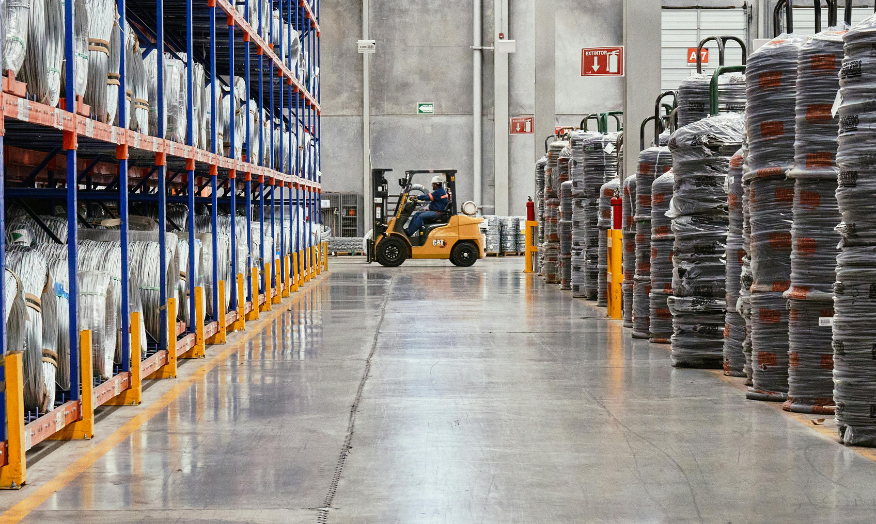
Warehouse-Al-Jessour

For decades, the UAE’s construction industry has been powered by a highly connected global supply chain. Materials, technologies and products sourced from around the world have helped build everything from residential communities and commercial developments to industrial facilities and major infrastructure.

That global connectivity remains a strength.

But in 2026, another important shift is accelerating alongside it: the growing strategic importance of local manufacturing and local sourcing.

Across the UAE, initiatives supporting domestic industrial capacity are encouraging more products to be manufactured within the country. At the same time, recent disruption to international supply chains has highlighted the value of having critical materials available closer to where they are needed.

For the construction industry, “Made in the UAE” is therefore becoming about more than country of origin.

It is increasingly about resilience, responsiveness and long-term industrial capability.

Why Is Local Sourcing Becoming More Important in the UAE?

Several forces are driving the shift.

The UAE continues to expand its industrial base as part of its broader economic diversification strategy. Initiatives such as Make it in the Emirates are creating opportunities for manufacturers to establish and expand production capabilities within the country.

Major organisations are also placing greater emphasis on localisation and In-Country Value.

For contractors and developers, meanwhile, utilizing materials manufactured or stocked closer to the project ensures greater reliability and significantly reduces exposure to international logistics risks.

The result is an increasingly connected ecosystem involving local manufacturing, local distribution and global expertise.

Does Local Sourcing Mean Replacing Imported Building Materials?

No.

The UAE construction market is diverse, and imported products will continue to play an important role. Many specialist products, technologies and established international brands form an essential part of project specifications.

The opportunity is not to choose between “local” and “global.”

It is to create a stronger balance between the two.

International sourcing provides access to global technologies and product diversity. Local manufacturing can add shorter supply chains, responsiveness and domestic production capacity.

Together, they can create a stronger construction supply ecosystem.

How Can Local Manufacturing Improve Supply Chain Resilience?

One of the clearest advantages is proximity.

An imported product may pass through several stages before reaching a UAE construction site: overseas production, port handling, international shipping, customs clearance, warehousing and domestic distribution.

Each additional stage introduces a potential variable.

Local production cannot eliminate every supply-chain risk—raw materials themselves may still be imported—but it can shorten parts of the chain.

That can provide contractors with:

  • improved visibility over production and availability;
  • potentially shorter replenishment cycles;
  • faster response to changing requirements;
  • reduced exposure to some international shipping disruptions; and
  • greater flexibility when project quantities change.

For high-volume construction materials, these advantages can become particularly significant.

Can Local Sourcing Support Faster Project Execution?

Potentially, yes.

Construction projects rarely proceed exactly according to the original procurement plan.

Quantities change. Site conditions evolve. Additional materials are required. A subcontractor may need stock earlier than expected.

When materials are manufactured, stocked or distributed within the UAE, procurement teams may be able to respond more quickly to these changes.

The value is not simply faster delivery.

It is greater flexibility during project execution.

And in a sector where time has a direct commercial value, flexibility matters.

How Does Local Manufacturing Support Quality and Visibility?

Local sourcing should never mean compromising on specification or quality.

Instead, the growth of sophisticated UAE manufacturing can give contractors additional options that meet required technical standards while being produced closer to the end market.

Proximity can also make communication between manufacturers, distributors and customers easier.

For large projects, this can support clearer technical coordination, product availability discussions and planning around future demand.

Ultimately, sourcing decisions should continue to be based on the correct specification, required certifications, quality, commercial viability and project needs—regardless of where a product is manufactured.

What Does Local Manufacturing Mean for the UAE Economy?

The impact extends well beyond individual construction projects.

Every new manufacturing capability contributes to a broader industrial ecosystem involving engineering, logistics, warehousing, transportation, technical services and skilled employment.

This creates a multiplier effect.

Instead of value being generated only when a finished product is sold, more stages of the value chain can take place within the UAE.

Over time, stronger domestic industrial capability can also help the country develop deeper technical expertise and greater economic resilience.

Why Distribution Still Matters in a More Localised Market

Manufacturing a product within the UAE does not automatically mean it is available exactly where and when a contractor needs it.

The link between manufacturing and the construction site remains distribution.

Warehouses, showrooms, transportation fleets and inventory planning convert production capacity into actual project availability.

This is why distributors remain an essential part of the localisation story.

A strong construction supply ecosystem requires:

Manufacturing → Inventory → Distribution → Project Site

Each part strengthens the next.

From Building Material Distribution to a Stronger UAE Supply Ecosystem

For established building material companies, the rise of local manufacturing creates an opportunity to evolve.

The distributor of the future will not simply connect overseas manufacturers with UAE customers.

It can connect global brands, UAE manufacturers, contractors, developers and project sites through one integrated supply network.

That model gives procurement teams greater flexibility. Depending on specifications and project requirements, customers can access internationally sourced products alongside locally available and locally manufactured alternatives.

Al Jessour and the Next Chapter of UAE Manufacturing

For Al Jessour, this evolution is particularly meaningful.

Since 1996, Al Jessour Building Materials has grown alongside the UAE’s construction industry, building an extensive distribution footprint across the country.

The Group’s journey is now expanding beyond distribution.

In February 2026, Al Jessour Steel Industries (AJSI) entered manufacturing in the UAE, marking an important new chapter for the business. With its first manufacturing facility operational and another factory underway, the move reflects a broader ambition to contribute not only to the distribution of construction materials, but also to the UAE’s growing industrial ecosystem.

This progression—from trading and distribution towards manufacturing—mirrors a wider change taking place across the country.

It also brings different parts of the construction supply chain closer together: manufacturing capability, established warehousing, market knowledge and distribution reach.

Building More Within the UAE

The UAE construction industry’s global connections will remain fundamental to its success.

But the future is increasingly about strengthening what sits alongside those connections.

More domestic manufacturing. Stronger local inventories. More responsive distribution. Greater industrial capability.

For contractors, local sourcing can provide another layer of resilience and flexibility.

For manufacturers and distributors, it creates opportunities to build capabilities closer to their customers.

And for the UAE, it contributes to a larger ambition: developing an economy that does not only build world-class projects, but increasingly manufactures the materials that help build them.

Frequently Asked Questions

What is local sourcing in the construction industry?

Local sourcing means procuring building materials, products or components manufactured or readily available within the domestic market rather than relying entirely on overseas supply.

Why is the UAE encouraging local manufacturing?

Local manufacturing supports economic diversification, industrial capability, supply-chain resilience, skilled employment and greater value creation within the UAE.

Does UAE-made automatically mean better than imported?

No. Product selection should always depend on specifications, standards, certifications, quality and project requirements. Local manufacturing provides additional sourcing options rather than automatically replacing international products.

Can local sourcing reduce construction lead times?

It can. Materials manufactured or stocked within the UAE may have shorter replenishment cycles and less exposure to certain international shipping delays, although actual lead times depend on product and availability.

What is In-Country Value in the UAE?

In-Country Value, or ICV, is an approach that encourages organisations to increase the economic value generated within the UAE through areas such as local procurement, manufacturing, investment and employment.

What is Al Jessour Steel Industries?

Al Jessour Steel Industries (AJSI) represents the Al Jessour Group’s expansion into UAE manufacturing. Manufacturing operations began in February 2026, with one factory operational and another facility underway.

Will imported building materials remain important in the UAE?

Yes. The UAE construction sector will continue to benefit from global brands and international supply networks. The emerging model is likely to combine global sourcing with stronger UAE manufacturing and local distribution.
 

Waterproofing in the UAE: Protecting Buildings Against Heat, Humidity and Water Damage

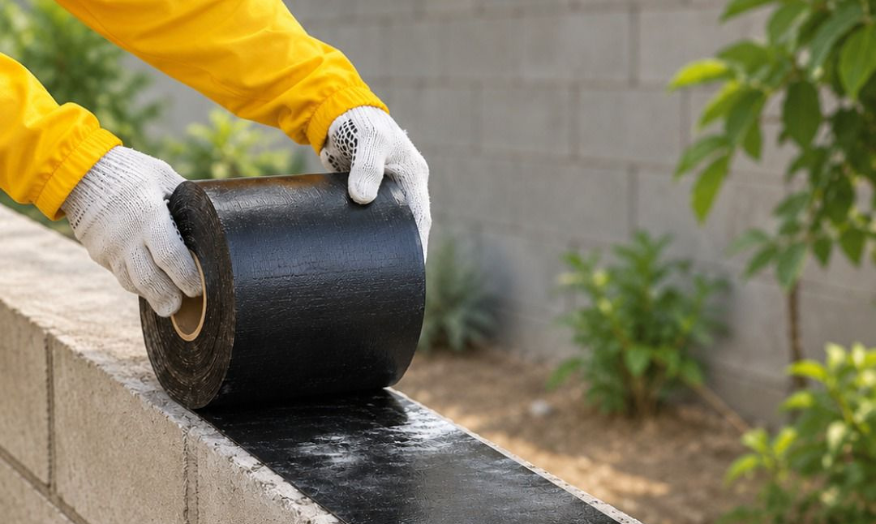
Applying-waterproofing-membrane-to-concrete-wall-Al-Jessour

Waterproofing may remain invisible once a building is completed, but its performance can have a major influence on the building’s durability.

A successful waterproofing system protects structural and finishing elements from unwanted water penetration. When waterproofing fails, the visible signs may begin with a damp patch, staining or peeling paint—but the underlying problem can become much more extensive.

In the UAE, waterproofing deserves particular attention because buildings are exposed to a demanding combination of high temperatures, strong solar exposure, humidity, condensation and occasional heavy rainfall.

For contractors and property owners, waterproofing should therefore not be treated simply as another finishing activity.

It is a long-term protection system.

Why Is Waterproofing Important in the UAE?

It is easy to associate waterproofing mainly with countries that experience frequent rainfall.

However, rainfall is only one source of moisture.

Buildings in the UAE can encounter water and moisture through bathrooms and kitchens, roof drainage, irrigation, swimming pools, groundwater, condensation, plumbing systems and occasional intense rainfall.

At the same time, exposed building elements can experience significant temperature changes.

Repeated heating and cooling can cause materials to expand and contract. Joints, penetrations and interfaces between different materials therefore require particular attention.

An effective waterproofing strategy needs to consider the entire environment in which the building operates.

Which Areas of a Building Need Waterproofing?

Waterproofing requirements vary according to where water exposure is likely to occur.

Roofs

Roofs are directly exposed to sunlight and weather.

Waterproofing systems used here must be suitable for the substrate and expected environmental exposure. Particular attention should be given to drainage points, joints, penetrations and transitions.

Even a small weakness can allow water to move beneath the finished surface and make the eventual source of leakage difficult to identify.

Bathrooms and Wet Areas

Bathrooms, kitchens and utility areas experience repeated water exposure.

Waterproofing below tiles helps prevent moisture from reaching screeds, walls and adjoining spaces.

Corners, pipe penetrations, floor drains and wall-to-floor junctions are particularly important because these are common locations for discontinuities in the waterproofing layer.

Foundations and Below-Ground Structures

Below-ground waterproofing helps protect foundations, basements and other structural elements against contact with ground moisture and water.

Because these systems can become difficult to access after construction is completed, correct material selection and application are particularly important.

Balconies and Terraces

Balconies combine weather exposure with numerous construction details, including doors, drains, edges and wall junctions.

Proper falls, drainage and waterproofing need to work together. A high-quality membrane cannot compensate for poor drainage design.

Water Tanks and Other Water-Retaining Areas

Water-retaining structures require systems specifically suited to their application.

The selected product must be compatible with the substrate and intended use, and installation should follow the manufacturer’s technical requirements.

What Are Common Types of Waterproofing Materials?

There is no single waterproofing material suitable for every application.

Bituminous Waterproofing

Bitumen-based products are widely used in construction and can include membranes, coatings and emulsions.

Depending on the system, they may be used for roofs, foundations and other protected areas.

Sheet Membranes

Pre-manufactured waterproofing sheets provide a continuous barrier when correctly installed.

Their performance depends heavily on correct overlaps, joints, detailing and substrate preparation.

Liquid-Applied Waterproofing

Liquid systems are applied to a prepared surface and cure to form a continuous layer.

They can be particularly useful around complex shapes and details because the system can conform to the surface.

Cementitious Waterproofing

Cement-based waterproofing systems are commonly used on concrete and masonry substrates and may be suitable for wet areas, water-retaining structures or other applications depending on product specifications.

The correct solution should always be selected according to the specific project and manufacturer’s technical guidance.

Why Does Surface Preparation Matter?

Even a high-performance waterproofing product can fail when applied to an unsuitable surface.

Before application, the substrate generally needs to be structurally sound, clean and prepared according to the selected system’s requirements.

Dust, oil, loose particles, sharp projections, cracks or excessive surface irregularities can interfere with adhesion and continuity.

This makes surface preparation one of the most important—and sometimes underestimated—parts of waterproofing.

Good waterproofing begins before the waterproofing material is applied.

Where Do Waterproofing Failures Commonly Occur?

Failures often occur at details rather than across large uninterrupted areas.

Potentially vulnerable locations include:

  • pipe penetrations;
  • drainage outlets;
  • expansion and construction joints;
  • corners;
  • wall-to-floor junctions;
  • membrane overlaps;
  • parapets; and
  • transitions between different substrates.

These areas require careful detailing because they interrupt the continuity of the waterproofing layer.

Application quality is therefore just as important as product quality.

Why Is Drainage Part of Waterproofing?

Waterproofing and drainage should work as a system.

If water remains trapped or ponds for prolonged periods, the waterproofing layer can be placed under unnecessary stress.

Correct slopes and properly positioned, unobstructed drains help move water away efficiently.

This is especially important on roofs, terraces and balconies.

A useful principle is:

Waterproofing keeps water out. Good drainage helps take water away.

Both matter.

What Happens When Waterproofing Fails?

Early warning signs can include damp patches, staining, blistering paint, mould, musty odours or deterioration of finishes.

However, simply repairing the visible surface may not solve the underlying problem.

Water can travel behind finishes or through construction interfaces before becoming visible. The point where a damp patch appears may therefore not be the point where water entered.

For this reason, proper investigation of the source is important before repair work begins.

Is Waterproofing a Cost or a Long-Term Investment?

Waterproofing represents a relatively small part of many construction projects when compared with the potential consequences of failure.

Repairing a waterproofing system after tiles, screeds, ceilings, landscaping or other finishes have been installed can require removal and reinstatement of multiple layers.

There may also be disruption to occupants and adjoining spaces.

The better question is therefore not simply:

“How much does waterproofing cost?”

It is:

“What could waterproofing failure cost later?”

Quality materials, correct specification and proper application can help protect the investment made in everything constructed above and around the waterproofing layer.

Getting the Right Waterproofing Materials in the UAE

Different areas of a project require different waterproofing approaches, making access to the right materials important.

Al Jessour Building Materials supplies a broad range of construction products across the UAE, including waterproofing solutions alongside cement, steel, plywood, paints, sanitaryware, power tools and other project essentials.

With an extensive network of showrooms and warehouses across the country and established delivery capabilities, Al Jessour helps contractors source multiple categories of construction materials through a single supply network.

Because good construction is not only about what can be seen after completion.

Often, it is the layers underneath that protect everything above them.

Frequently Asked Questions

Why is waterproofing necessary in the UAE despite limited rainfall?

Buildings in the UAE face moisture from bathrooms, plumbing, irrigation, groundwater, condensation, swimming pools and occasional heavy rain. Heat and temperature changes can also place additional demands on building systems.

Which parts of a building usually require waterproofing?

Common areas include roofs, bathrooms, kitchens, balconies, terraces, foundations, basements, water tanks and other areas exposed to water or moisture.

What are the main types of waterproofing materials?

Common systems include bituminous membranes and coatings, sheet membranes, liquid-applied systems and cementitious waterproofing. Suitability depends on the application and substrate.

What is the best waterproofing solution for a roof in the UAE?

There is no single solution suitable for every roof. Selection should consider roof construction, substrate, exposure, drainage, expected movement and the manufacturer’s technical specifications.

Why does waterproofing fail?

Common causes include poor surface preparation, incorrect material selection, inadequate detailing, improper installation, damaged membranes, poor drainage and failures around joints or penetrations.

Can waterproofing be applied over an existing surface?

In some cases it can, but this depends on the condition and compatibility of the existing substrate and the waterproofing system. The surface should be inspected and prepared according to manufacturer recommendations.

How can contractors improve waterproofing durability?

Correct system selection, thorough surface preparation, careful detailing, proper drainage, installation according to manufacturer guidance and inspection before covering the waterproofing layer can all improve long-term performance.

Where can contractors source waterproofing materials in the UAE?

Building material suppliers such as Al Jessour provide waterproofing solutions alongside other construction materials through their showroom, warehouse and delivery networks across the UAE.


The Contractor’s Guide to Selecting and Using Ladders Safely on UAE Construction Sites

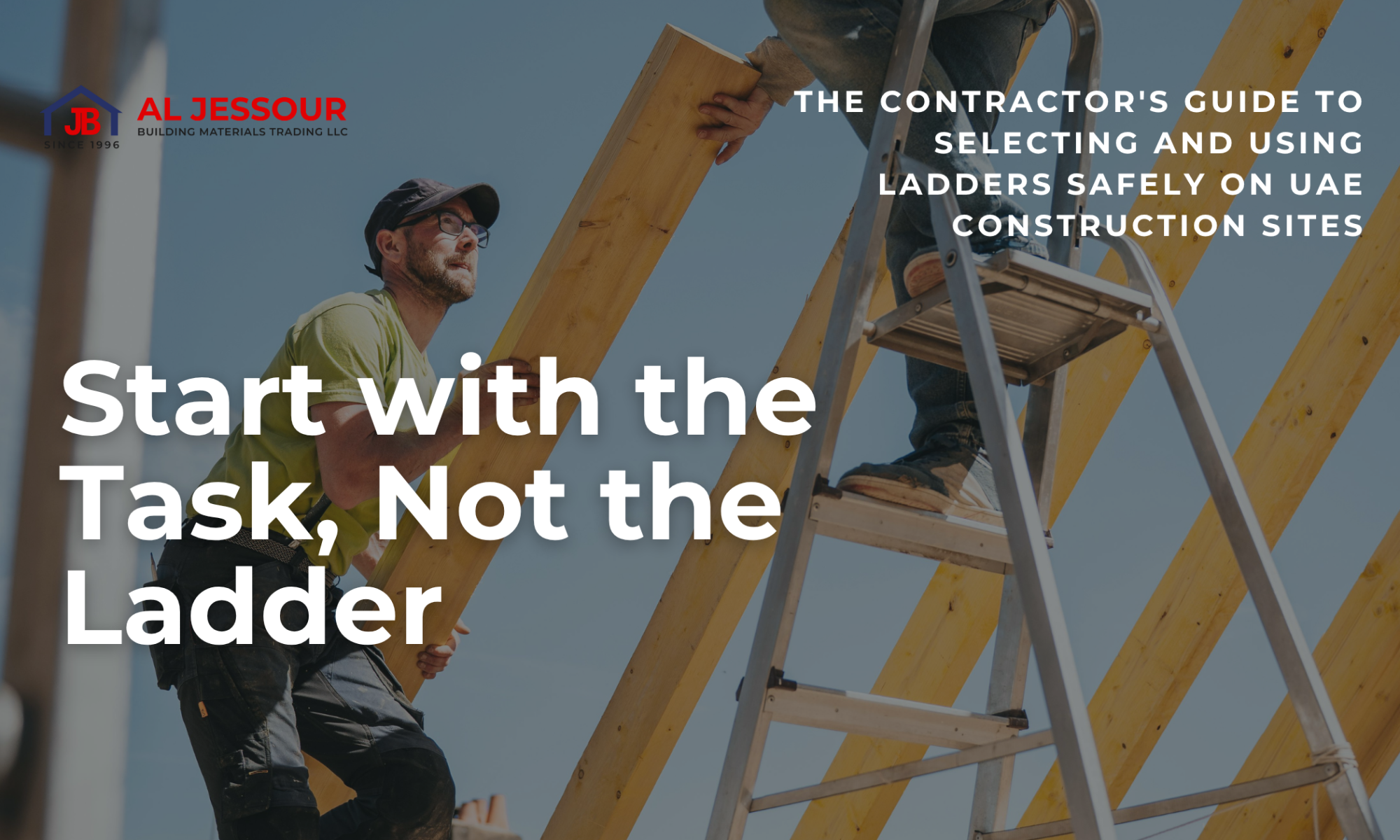
Contractor-using-ladder-safely-on-UAE-construction-site-Al-Jessour

Falls from height are among the leading causes of serious injury on UAE construction and fit-out sites. In the majority of incidents, the root cause is not carelessness — it is the wrong ladder for the task, used at the wrong angle, on the wrong surface, or rated for the wrong load.

Al Jessour stocks a comprehensive range of professional ladders for construction, fit-out, and industrial use. This guide gives site engineers, HSE officers, and procurement managers the knowledge to select the right ladder for every job — and the compliance context to ensure purchases meet UAE regulatory requirements.

Start with the Task, Not the Ladder

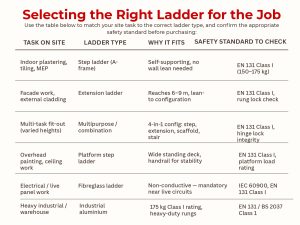
The most common procurement mistake is buying a ladder based on height alone. Height is only one of four variables that should drive your selection:

  • Height required: measured from standing level to the working point, not the top of the ladder.
  • Load: the combined weight of the worker, clothing, tools, and any materials being carried. Always add at least 15 kg to the worker’s body weight when calculating.
  • Surface: level concrete, uneven ground, or sand each requires different base configurations.
  • Task type: a self-supporting task (tiling, MEP, painting) has different requirements from a lean-to task (facade access, external cladding).


UAE Compliance: The Standards That Apply on Site

Ladders used on regulated UAE construction sites must meet internationally recognised safety standards. The three most commonly cited across UAE project safety plans are:

  • EN 131 — the European standard, the most widely specified in the UAE. Class I (industrial use, up to 175 kg) is required for contractor use. Class II (domestic, 150 kg) is not compliant on commercial construction sites.
  • BS 2037 — the British standard equivalent, referenced in older UAE project specifications and some Abu Dhabi infrastructure contracts.
  • ANSI A14.2 — the American standard, referenced on US-designed projects, free zone developments, and some multinational contractor safety plans.

Always confirm with your project HSE officer which standard is referenced in the site safety plan before procuring. Al Jessour can provide product data sheets confirming standard compliance for every ladder in our range.

5 Mistakes That Cause Ladder Incidents on UAE Sites

  • Wrong angle on extension ladders: the safe working angle is 75 degrees — one unit out for every four units up. Too steep and the ladder tips backward; too shallow and the feet slip on smooth surfaces.
  • Ignoring soft ground: UAE construction sites often have uncompacted sand or gravel surfaces. Standard rubber feet provide no stability on soft ground — use base plates or stabiliser feet.
  • Exceeding the safe standing height: every ladder has a maximum standing rung marked. Working above it shifts the centre of gravity and significantly increases tip-over risk.
  • Carrying tools in hand while climbing: three points of contact must be maintained at all times. Tools should be carried in a belt pouch or hoisted separately.
  • Using a domestic-rated ladder on a commercial site: Class II ladders look identical to Class I at a glance but are not compliant for contractor use under OSHAD-SF and Dubai Municipality site regulations.

Aluminium vs. fibreglass: aluminium is the standard choice for most UAE site work — lightweight, corrosion-resistant, and easy to handle. Fibreglass is mandatory near live electrical installations. If your scope includes any electrical work at height, always specify fibreglass — it is non-conductive and the only safe option near live circuits.

Source Your Full Ladder Range from Al Jessour

We stock the complete range — step ladders, extension ladders, multipurpose combination ladders, platform step ladders, and heavy-duty industrial aluminium ladders — all available for delivery across the UAE or click and collect from our showrooms in Ajman, Dubai, and Abu Dhabi. Product data sheets confirming EN 131 and BS 2037 compliance are available on request.

For fit-out projects requiring multiple ladder types across a large site, our team can advise on the most cost-effective combination to cover every task with the minimum number of units.

Browse our full ladder range at aljessour.com  |  Call 800 5575 for project quantities


The Complete Sanitaryware Specification Guide for UAE Construction & Fit-Out Projects

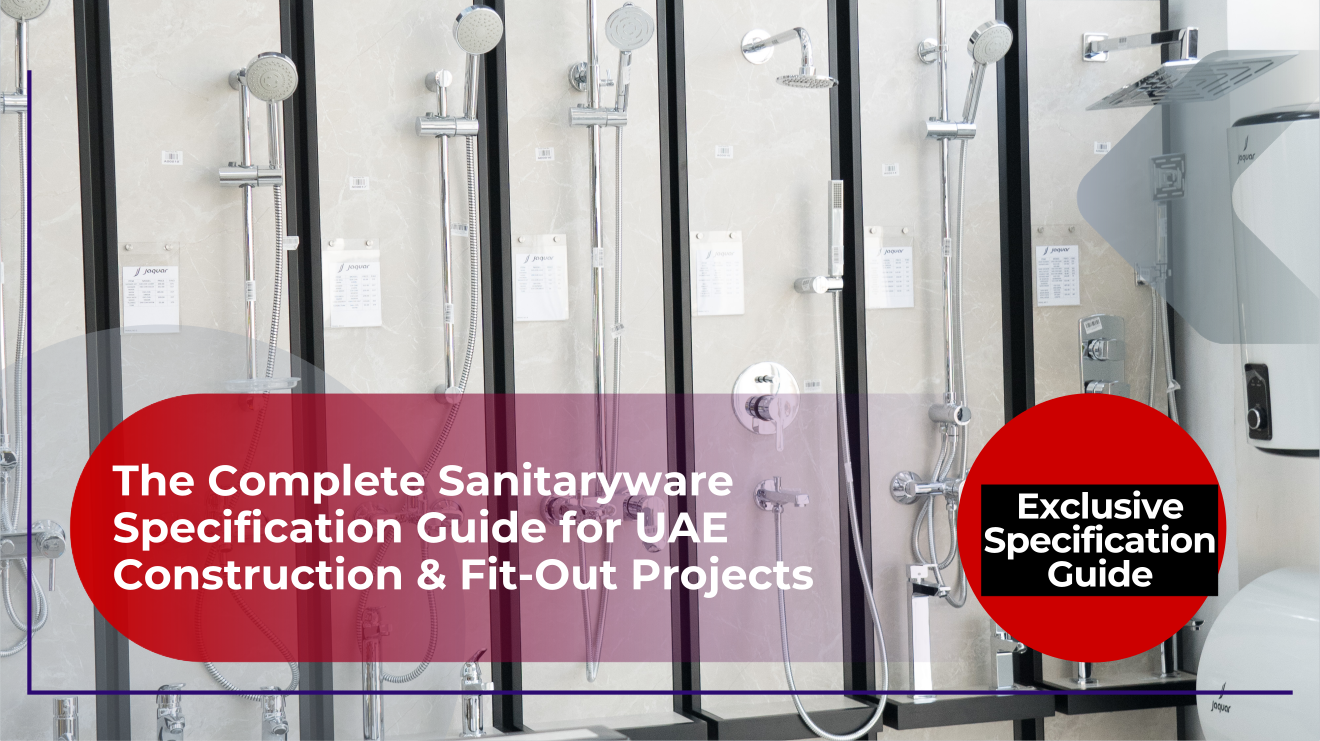
Wall mounted showers and sanitaryware fittings display - Al-Jessour

Sanitaryware is one of the highest-touch product categories in any building — used dozens of times daily by residents, guests, and staff. Yet on many UAE projects, it is specified late, procured under price pressure, and installed without a coherent room-by-room plan. The result is mismatched finishes, maintenance callbacks, and unhappy end users.

As a one-stop supplier of the complete Jaquar range — faucets, showers, flushing systems, WCs, bath accessories, diverters, and washroom accessories — Al Jessour works with interior designers, fit-out contractors, and procurement managers to bring the entire bathroom specification under one roof. This guide covers what to specify, room by room, and what performance criteria matter in the UAE context.

Why Sanitaryware Specification Deserves More Attention

Three things go wrong when sanitaryware is treated as an afterthought on UAE projects:

  • Finish mismatch: faucets, towel rails, and accessories sourced from different suppliers in ‘chrome’ deliver visibly different tones under bathroom lighting. Specifying from a single coordinated range eliminates this.
  • Pressure incompatibility: UAE water supply pressure varies significantly between building floors and between municipalities. Fittings not rated for the full pressure range develop drips and leaks within the first year.
  • Hard water damage: UAE tap water has high mineral content. Fittings without ceramic disc cartridges and anti-scale nozzles scale up and fail faster — driving up maintenance costs that building owners ultimately bear.


Key Technical Criteria for UAE Conditions

Ceramic Disc Cartridges

Every mixer tap and faucet should use a ceramic disc cartridge rather than a rubber washer. Ceramic discs handle UAE hard water far better, resist the grit and minerals that wear rubber washers down, and last significantly longer before requiring replacement. This is the single most important specification detail for faucets on any UAE project.

Dual-Flush Flushing Systems

Dubai Municipality and DEWA water efficiency requirements increasingly reference dual-flush cisterns for new residential and commercial builds. A 3/6 litre dual-flush system reduces water consumption in washrooms by up to 40% compared to a single-flush 9-litre cistern — a meaningful operational saving on any high-occupancy building.

Concealed vs. Exposed Cisterns

For commercial washrooms and premium residential bathrooms, concealed in-wall cisterns deliver a clean aesthetic and make maintenance access simpler than exposed units. For standard residential applications, exposed close-coupled cisterns are practical and cost-effective. Al Jessour stocks both configurations across the Jaquar flushing systems range.

Pressure-Balancing Shower Valves

In any building where multiple showers or outlets may run simultaneously — hotels, residential towers, labour accommodation — a pressure-balancing valve prevents the sudden temperature swings that occur when someone flushes a toilet while another person is showering. It is a specification detail that significantly affects tenant comfort and is worth including from the outset.

Procurement tip: Specifying your entire bathroom — faucets, showers, accessories, flushing systems, and sanitaryware — from a single coordinated range eliminates finish mismatch, simplifies procurement, and gives you a single point of contact for warranty and aftercare.

Source Your Full Bathroom Specification from Al Jessour

We carry the complete Jaquar range across all product categories — faucets, mixers, showers, overhead and handheld sets, flushing systems, concealed and exposed cisterns, wall-hung WCs, bath accessories, diverters, and washroom accessories. Everything is available in coordinated finishes including chrome, brushed nickel, matte black, and rose gold.

Our showrooms in across the UAE allow designers and procurement teams to view the full range before specifying. Bulk project pricing and delivery across all UAE emirates is available.

Browse the full sanitaryware range at aljessour.com  |  Visit a showroom or call 800 5575

Everything You Need to Know Before Specifying a Water Heater for a UAE Project

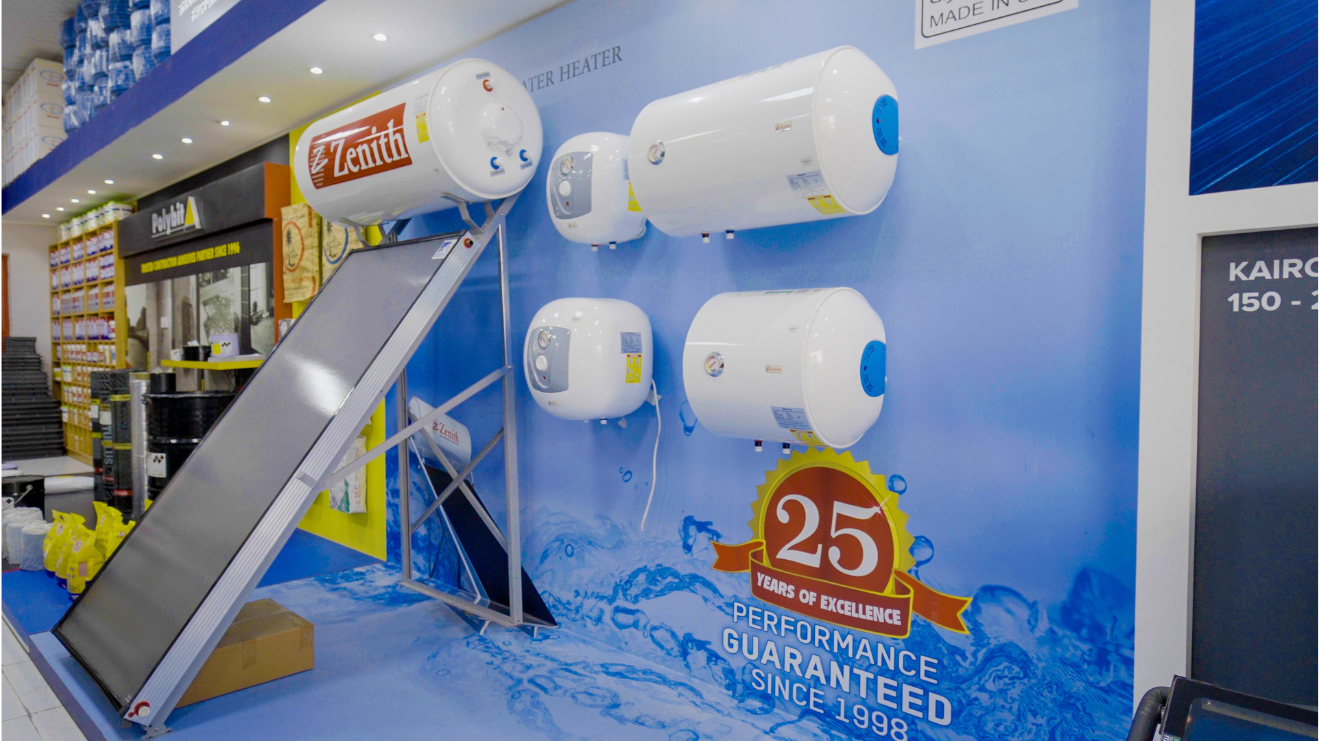
Zenith-water-heaters-display-with-solar-panel-in-showroom-Al-Jessour

Water heaters are one of the most overlooked items at the specification stage of a UAE construction or fit-out project — until something goes wrong. An undersized unit means unhappy tenants from day one. The wrong technology in a high-rise tower drives up electricity costs for years. A unit not rated for UAE inlet water temperatures fails within two summer cycles.

At Al Jessour, we supply water heaters from leading brands including Jaquar, Ariston and Zenith, and our team works with contractors, procurement managers, and developers across the UAE every day. Here is the neutral, practical knowledge you need to make the right call — regardless of brand.

The 3 Questions to Answer Before You Specify

Before looking at any product, answer these three questions and the right technology will become obvious:

  • How many people or outlets will this unit serve simultaneously? This determines storage capacity or flow rate.
  • What is the project’s energy or sustainability requirement? Standard electric, heat pump, or solar-ready?
  • What is the available space and installation configuration? Wall-mounted, floor-standing, concealed?


Water Heater Technologies: A Plain-English Guide

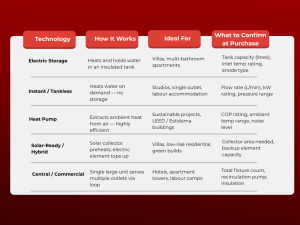
There are five main water heater technologies used across UAE projects. Each serves a different combination of project size, energy requirement, and budget. The table below summarises when each is appropriate and what technical details to confirm at the point of purchase:

The UAE Factor: What Most Guides Don’t Tell You

Standard water heater specifications are written for temperate climates where cold water supply enters at 10–15°C. In the UAE, cold water supply regularly reaches 30–35°C in summer — which fundamentally changes how a water heater performs.

  • Storage units with a small temperature differential between inlet and setpoint will short-cycle, wearing out elements and thermostats faster than expected.
  • Instant heaters sized for a 25°C temperature rise will deliver lukewarm output when inlet water is already 35°C — specify a unit with a higher kW rating than the nameplate suggests.
  • Tank corrosion from hard, high-mineral UAE water is the number one cause of early tank failure. Always confirm the inner tank protection system — titanium enamel, glass-lined, or magnesium anode — before purchasing.
  • For labour accommodation and large residential projects, heat pump systems cut water heating electricity costs by up to 70% compared to standard electric storage. The payback period in UAE conditions is typically under three years.

Sizing in Practice: A Quick Reference

  • Studio or 1-bed apartment: 30–50 L storage, or a single instant unit
  • 2–3 bedroom apartment: 80–120 L storage
  • 4–5 bedroom villa: 150–200 L, or twin 100 L units on separate circuits
  • Labour accommodation (per 10 occupants): 200–300 L, or solar-assisted system
  • Commercial buildings: calculate 15–20 L per fixture and add 20% contingency for peak demand


Always specify a unit rated for inlet water temperatures above 35°C. This single detail separates products built for the Gulf from those engineered for European climates — and it makes a significant difference to unit lifespan.

Find the Right Water Heater at Al Jessour

We stock a full range of electric storage, instant, heat pump, and solar-ready water heaters from Jaquar, Ariston and Zentih — covering every project type from a single studio apartment to a 300-unit residential tower. Our team can advise on the right capacity, technology, and configuration for your specific project, with delivery across all UAE emirates.

Browse our water heater range or request a project quote at aljessour.com  |  Call 800 5575


Building Materials Supply Chain in the UAE: Challenges and Solutions

Truck loaded with building materials for UAE supply chain - Al-jessour

The UAE construction sector thrives on ambitious timelines, but supply chain challenges can often slow progress. Delays in global shipping, fluctuating raw material prices, and complex regulations all affect the smooth flow of building materials in the UAE. For contractors, these challenges can result in cost overruns and missed deadlines.

A streamlined construction supply chain in Dubai is essential to keep projects on track. Reliable sourcing, strong logistics networks, and partnerships with experienced suppliers ensure that materials are delivered on time and in the right quantities. Working with a dependable UAE building supplier minimizes the risks associated with fragmented procurement.

At Al Jessour Building Materials, we have built a reputation for efficiency and reliability. With decades of experience in the industry, we provide contractors with a seamless supply chain experience — from cement and steel to paints, sanitary ware, and accessories. Our strong vendor network and bulk procurement options ensure that projects face fewer disruptions and achieve cost efficiency.

Why Quality Sanitary Ware Matters in Commercial Projects

Sanitary ware and shower fittings showroom display - Al-Jessour

When it comes to commercial construction, functionality and aesthetics must go hand in hand. Choosing the right sanitary ware in the UAE is crucial for offices, malls, hotels, and public facilities, where heavy usage demands products that are durable, efficient, and stylish.

High-quality bathroom fittings in Dubai ensure not only longevity but also lower maintenance costs, which is vital in commercial spaces where downtime is expensive. From water-saving fixtures to premium finishes, the right sanitary solutions create a lasting impression for both users and stakeholders.

Contractors who compromise on quality often face issues like leaks, breakages, and frequent replacements, which add to project costs over time. Working with a reliable supplier ensures that commercial sanitary solutions meet international standards and align with sustainability goals.

At Al Jessour Building Materials, we partner with leading global brands such as Jaquar and Ariston to provide sanitary ware that combines durability with design. Our wide range ensures that contractors find the perfect match for their projects, from luxury hotels to office towers.

Smart Procurement: How Contractors Save Costs with Bulk Buying

Bulk-buy-building-materials-al-jessour

In the UAE’s competitive construction industry, cost control is often the deciding factor for project success. One of the most effective strategies contractors rely on is bulk buying of building materials in the UAE. By purchasing cement, steel, paints, sanitary ware, and accessories in large quantities, contractors not only ensure uninterrupted supply but also achieve significant construction cost savings.

Bulk procurement eliminates the challenges of fluctuating prices and multiple vendor negotiations. Instead of coordinating with different suppliers, contractors can work with a trusted partner who provides a wide range of contractor supplies under one roof. This streamlines logistics, reduces paperwork, and ensures consistent quality across all materials.

At Al Jessour Building Materials, we offer contractors access to bulk buying options that are both economical and efficient. Whether you’re managing a large-scale commercial project or a residential development, our one-stop supply solution guarantees reliability, timely delivery, and cost-effectiveness.

How to Select the Right Paints for UAE Climate Conditions

jotun-paint-shop-interior-al-jessour

The UAE’s extreme climate presents a unique challenge when it comes to construction finishing, especially painting. Scorching summer heat, high humidity, and frequent dust storms can all take a toll on buildings. That’s why selecting the right paints in the UAE is not just about aesthetics — it’s about protection and performance.

Contractors and homeowners must prioritize weather-resistant paints in Dubai that are designed for local climate conditions. High-quality exterior paints should have UV-resistant properties to prevent fading, as well as strong moisture and dust resistance to maintain a clean look. Interior paints, on the other hand, should offer durability, washability, and resistance to mold in humid areas.

Today, many advanced paint formulations are also eco-friendly, offering low-VOC options that improve indoor air quality while aligning with green building standards. Heat-reflective paints are another rising trend, helping reduce energy consumption by keeping buildings cooler.

As one of the leading building paints suppliers in the UAE, Al Jessour Building Materials offers a complete range of premium paints suited for both residential and commercial projects. Our catalog includes trusted brands that deliver long-lasting finishes, vibrant colors, and advanced protective qualities.

With the right selection, paints can do more than beautify a structure — they can protect, reduce maintenance costs, and contribute to sustainability. At Al Jessour, we guide contractors and customers in choosing paints that balance durability, efficiency, and design, ensuring every project stands strong against UAE’s demanding climate.

Sustainable Building Materials in the UAE: How Al Jessour Supports Green Construction

Jessour-showroom-exterior-picture

Across Dubai, Abu Dhabi, and other emirates, sustainability has become the foundation of modern construction. With the UAE’s commitment to a greener future, demand for sustainable building materials in the UAE is growing rapidly, shaping how projects are designed and executed.

Today’s contractors are looking for solutions that reduce carbon footprint, save energy, and extend building lifespans. Eco-cement with reduced clinker, recycled steel, insulated concrete blocks, and responsibly sourced wood are among the top choices. Even paints are evolving, with low-VOC, heat-reflective options gaining ground in green construction in Dubai.

Al Jessour Building Materials plays an important role as a trusted eco-friendly supplier. We provide a wide range of sustainable options including energy-saving paints, water-efficient sanitary ware, and eco-certified construction accessories. Our aim is to help contractors meet the requirements of green building codes such as Estidama and Dubai Green Building Regulations, while also adding long-term project value.

Sustainability is not only about compliance but also about building smarter communities. Developers and contractors who choose the right materials can lower operational costs, attract eco-conscious investors, and contribute positively to the UAE’s sustainability vision.

At Al Jessour, we go beyond supplying products — we act as a partner in responsible construction. From consultation to material selection, our team ensures that every project we support contributes to a healthier environment and a sustainable tomorrow.

Shopping cart0
There are no products in the cart!